27 vs 17

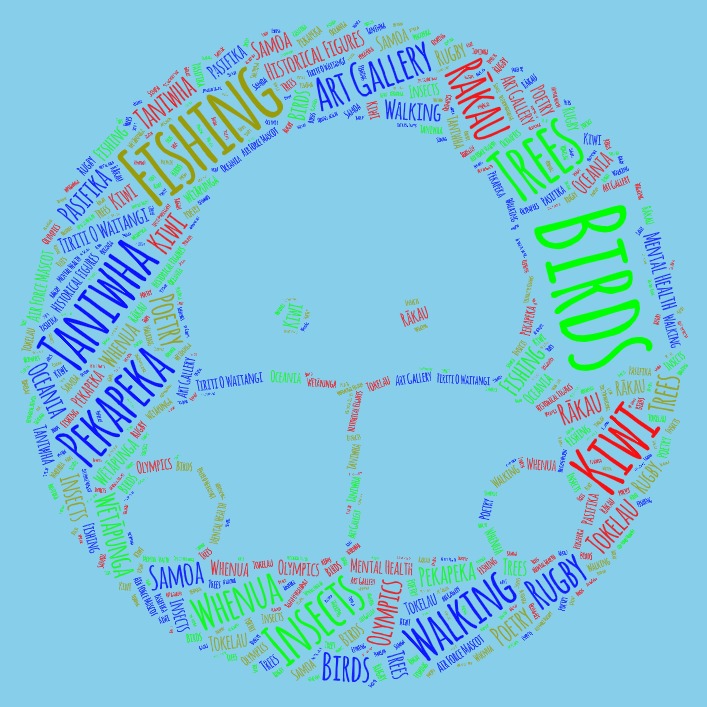
Notable Books … In comparison with last year, ten more non-fiction titles to read and scrutinise. The Fab Six panel ploughed through a wealth of New Zealand related topics and subjects, some better known than others, some close to our hearts, others fascinating and surprising, some fiercely debatable, some disappointingly marked by factual errors … Subjects varied immensely as you can see in the word cloud below. Not being able to put a book down, standing on a parking lot next to my EV recharging, speaks volumes about the quality of text and illustrations. It was my favourite book out of those 27 and now lives in a bookcase in my house. Guess which one it is – it made the Notable Books list for children and young people non-fiction.

Curious about the Storylines Notable Books list? You can find it here: https://www.storylines.org.nz/awards/storylines-notable-book-awards/storylines-notable-book-lists-2025/

Once the judging was finished, we received an invitation to consider being part of the judging panel for the Storylines Tessa Duder Award or the Storylines Tom Fitzgibbon Award for unpublished and original manuscripts for respectively young adults and junior fiction. I pondered for a while… volunteered… and was accepted on the panel for the Tessa Duder Award. Little did I know this requires reading 34 young adult manuscripts (about 70.000 words each) in about two months, Thirty-four!

To be continued…
how to rebuild a library

Kenya, Nairobi, McMillan Memorial Library, the oldest library in Nairobi. Opened in 1931 and built by the wife of Englishman William McMillan in tribute to him, with British books and only for “whites” until sometime in the sixties Africans are allowed access to this monumental building of a library and its collections. It’s been run by the County but the state of its collection and interior is underwhelming and deteriorated over the years.

Two women, one a writer (Shiro), the other a publisher (Wachuka), take it upon themselves – with no experience but with big dreams – to revitalise the McMillan Library and its two branches in Kaloleni and Makadara. Their project Book Bunk, a grand plan in need of money, helpers and political support, was filmed over six years (from 2017) and presented as How to build a library at the recent New Zealand DocEdge Festival.

Book Bunk raises plenty of post-colonial questions in search of Kenyan identity in the McMillan Library collections which, Shiro and Wachuka discover, do not represent their communities well. And Book Bunk grows into something much bigger: connecting and reaching communities through literature, arts, music, play, dance.

Discover an amazing dream of Titanic proportions coming true on www.bookbunk.org

notable books

Oh! Being asked again for the Storylines Book Awards filled me with pure joy! Did I have to think long and hard about my answer? Haha!

I’m in the six strong panel for junior non-fiction literature, like last year, with one person new (to me) and the others the same great bunch of reading/teaching/librarian enthusiasts from before. Since an initial introductory meeting online, we have buried our heads into the nominated books (12 submitted at this point, not all available yet, so spanking new are they), writing impressions/surprises/disappointments on a shared spreadsheet guided by several criteria, tentatively finalised in a score.

The latter is not the end though. Soon enough we’ll meet again for discussions about what and how we see, appreciate or question in each publication. Comfortable in our own skins, we do not need to agree, we can adjust our scores and our preferences, or we can stick with our opinion.

I miserably fail at not reading the others’ comments before I have formulated my own, but others’ experienced eyes help with a differently angled read of a book.

So far, I have read and explored six books bringing attention to an ugly insect duckling, Pasifika poetry, mental wellbeing, multi-day walking, fighter pilots and a historical story. Illustrations are an integral part of non-fiction books and can be a deal breaker in tandem with the overall design. I spy with my little eye …

Let’s delve into number 7, plenty of content to read!   

tea in the bookshop

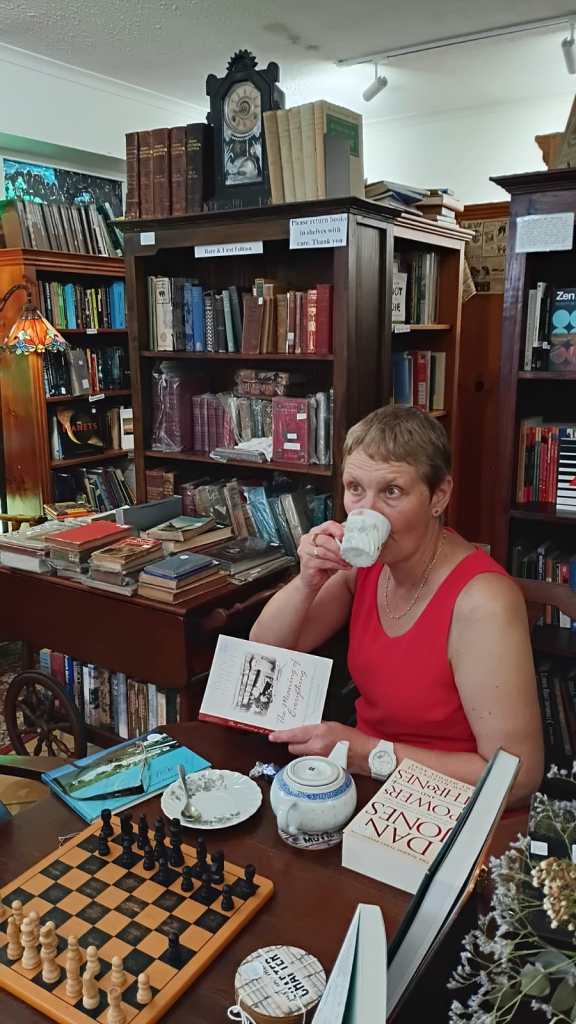
He offered to make me a pot of tea and disappeared to the small kitchenette at the back of the shop. It was our second visit to this delightful place of old and new books, curious mixtures on bulging shelves and above, left on chairs and in the creases of comfortable couches, stacked on and under small tables.

A bookshop so invitingly and welcomingly furnished, not just because of the antiques (including a couple of pianos you are allowed to play if you properly could) but mainly because of the cozy mess of books strewn around and drawings in the children’s alcove littering the floor amidst the bean bags.

Staff dressed in fabulous handmade attire of bookish fabric, a space on the pavement to sit and browse through second hand literature and then there was the pot of tea, placed on the big table in the bigger room of the shop with the message from the owner (I suspect) to enjoy, to take my time and stay as long as I liked while browsing. My idea of heaven! He came a bit later to borrow some of my/his tea in a tiny cup of which, he explained, he had many during the day.

While I like order and clean lines and modern, the charm of this bookshop in Port Douglas (Queensland, Australia) touched me in many ways. We left obviously with books purchased and a truly memorable experience. I almost forgot about Bailey, who is The Book Lounge’s shop dog and loves your cuddles when you read him a story.

Exit jury

Let’s start with the end. The end of being one of six judges. The six judges of the Storylines Notable Book Awards. Discovering books worthy of the adjective notable amongst 17 submitted NZ non-fiction books for children.  

And reading and re-reading we did! Shared reflections, comments and hesitations in a spreadsheet, articulated in, and may I stress, very amicable discussions online. One, for some two, cups-of-tea-long discussions spearheaded by convenor Rosemary who redirected when necessary, summarised where needed, suggested a show of hands to indicate notable and a thumbs down if the book did not quite reach that notable bar. Last but not least, she organised sending books to us panel members spread over New Zealand, not a logistical challenge to be sniffed at.

From our comfortable chairs in our homes Celeste, Helen, Penny, Rosemary, Emma and I meandered along this colourful river of te reo Māori and English, watercolour illustrations, funny insertions, breathtaking artwork, challenging puzzles (for the children that is!), QR-codes, cover design, lay-out, production quality, the richness of language, capturing content … Each author (and their teams) no doubt has worked incredibly hard and invested innumerable time agonising over all that what constitutes producing a book for children or young people. What a treasure cove we happened upon!

The Storylines Notable Book Awards honours not one but a list of several admirable and amazing literary products for children and young people in different categories – to flood bookstores and libraries now and later. We settled on an exciting list of non-fiction notable books.

Our temporary small yet tight-knitted, companiable club of book enthusiasts oozed so much passion and enjoyment while debating the task at hand in earnest. Ka kite.

I wish I could finish with a reference to my personal pick of the notablest notable book. You will have to wait until the awards are announced sometime in November.     

Storylines Trust Te Whare Waituhi Tamariki and Friends of Storylines Te Pou o Te Whare Waituhi Tamariki together form New Zealand’s only national organisation working year-round to promote New Zealand children’s and young adult literature through activities that include a major national Story Tour to schools, early childhood centres and communities, and awards for writers, illustrators and those who work in the area of New Zealand children’s literature

judge and reader

We, the non-fiction children’s books panel,  are in the middle of it, of the reading, of the re-reading, the thumbing backwards and forwards through each book, peering over the illustrations, admiring the design, frowning at the cover, delighting in the language, being engrossed in the story, learning about Aotearoa’s creatures, environments, history, sport, te reo Māori … Being a judge for book awards wins the trophy for pleasure and fun from being a judge for a criminal trial no doubt.  

This reading in a jury-like way is fascinating, an exercise and learning experience in considering details and gaps in the production, content and illustrations to finally ponder whether this book as a whole can vie for the title of notable book.

Our six-strong panel is diligently reading, commenting, discussing impressions and debating scores of 14 non-fiction books to this date. We are not there yet. A couple of lost and truanting ones are soon to be sent out to our ready eyes and hands for the last reading sprint. To be followed by a final judging discussion… 

Secretly I hoped to keep some (all!) of these treasures of books … alas, back to sender.

the jury is out

Six women managed to meet online, on a weeknight, at the shortest of notice. I was duly impressed. A sign of enthusiasm and dedication to the task of judging New Zealand children’s non-fiction books? My guess is yes.  

Rosemary, our panel convenor, organised our first introductory meeting. She and we (Helen, Penny, Celeste, Emma and myself) bring loads of variety in life and work experiences, book knowledge and judging tips. I felt an instantaneous connection nestled in such a comfortable atmosphere. This is going to be exciting! Some have previous judging experiences, others don’t (including moi). In all our diversity we represent a forceful advocating voice for reading and loving books from early years throughout life. Helen warmly shared her granddaughter teaching her how to read an Anime comic 😊

Until publishers have nominated their selection for the Storylines Notable Awards by 31 August, we start (at random) reading eligible non-fiction children’s literature, meaning they need to have been published between 16 November 2023 and 15 November 2024. So far, a handful of non-fiction books have been submitted. For now, we read, take detailed notes, attempt to score those books and delve into the judges’ guidelines for some direction.  

This process is going to feel like a rollercoaster because by the end of September (barely two months away) our panel will have a couple of final meetings to whittle down contenders and make THE decision!

I purchased Patu by Gavin Bishop in November last year at the WaiPRU picture book seminar at Waikato University. Gavin was a keynote speaker. He is a talented and celebrated children’s author in New Zealand. (What an understatement!) I had the privilege to speak with him in person (and hear, to my astonishment, about his family’s connection to the Whakatāne area where I live) with my copy at the ready to be signed. His supersized book is a slow to read and digest work of art and history. It’s a worthwhile read, whether it will be nominated or not.    

i am judge

I am stoked! I am elated! I am excited! I am smiling! I have been accepted as a judge on the non-fiction panel of the Storylines Notable Book Awards! Five other people and our panel convenor join me on this exciting journey. To be honest, over the years I have applied many many times for different children’s books award panels and have been unsuccessful, until now.

From the Storylines Children’s Literature Charitable Trust of New Zealand | Te Whare Waituhi Tamariki o Aotearoa website about the Notable Book Awards:

“Since 1999 Storylines has produced an annual list of outstanding books for children and young people published by New Zealand authors and illustrators during the previous calendar year.

This annual list of Storylines Notable Books ensures that children, whānau, teachers, librarians and the public are aware of the large range of high quality New Zealand books being published.

Books are categorised as: Picture Book, Junior Fiction, Young Adult, Non-fiction and Te Reo Māori. There are up to ten awards in each category. 

Storylines Notable Books are selected by expert panels in each category. These panels include children’s and YA (young adult) librarians, authors, illustrators, teachers, academics and whānau; several members have served as judges for the previous New Zealand Book Trust, New Zealand Post and LIANZA Book Awards.

The Storylines Notable Book Awards are presented at Storylines’ annual event in November.” 

Follow my voyage into the sea of children’s non-fiction literature and navigating high winds, wild water and finding treasure with the rest of the crew.

cain’s jawbone

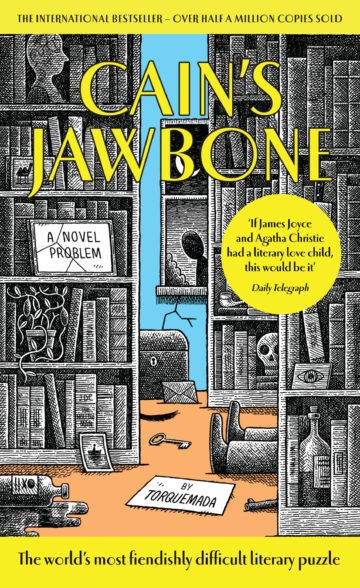
In a Radio New Zealand radio interview in early December last year I listened with increasing interest and growing excitement to Jesse Mulligan speaking with UK-based Kiwi publisher John Mitchinson. He is the co-founder of Unbound Publishing. In 2019 this crowdfunding publishing house rediscovered and republished Cain’s Jawbone, a complex literary puzzle originally published in 1934.

The Unbound website describes the book as follows [Cain’s Jawbone: A Novel Problem by Edward Powys Mathers — Unbound]

Six murders. One hundred pages. Millions of possible combinations… but only one is correct. Can you solve Torquemada’s murder mystery?

In 1934, the Observer’s cryptic crossword compiler, Edward Powys Mathers (aka Torquemada), released a novel that was simultaneously a murder mystery and the most fiendishly difficult literary puzzle ever written.

The pages have been printed in an entirely haphazard order, but it is possible – through logic and intelligent reading – to sort the pages into the only correct order, revealing six murder victims and their respective murderers.

Dare you take it on?

Please note: this puzzle is extremely difficult and not for the faint-hearted.

The new release started to feature in social media postings (thanks TikTok!) and all over the world (online) groups formed to tackle this murder mystery. Many individuals wallpapered their house with the 100 pages of the book to find patterns and clues. So far, since the book’s inception, or in other words, in the last ninety years, only 4 people have solved the puzzle (if no new code crackers have surfaced since that number was released).  

A reasonably recent article about Cain’s Jawbone’s background and journey from the Washington Post (26 December 2022) website is worth a read: Solving ‘Cain’s Jawbone’ has turned a murder mystery into an obsession – The Washington Post

In November last year Harper Collins released a new edition in Australia and New Zealand. They are offering a $1200 prize pack to the person who can crack the code.

Not much time left to solve the mystery and I haven’t bought my copy yet!

p.s. My house does not have much wall space either…

languageless

Reading A man without words by Susan Schaller introduced me to the concept of languageless. This refers to a person, who is born deaf or loses their hearing shortly after birth, having absolutely no idea or concept of language, that language has something to do with words, with speaking and communicating, that words carry meaning, that words are connected to objects, actions, dreams and perspectives. Do you grasp what you just read?

Some (not all) deaf people have no concept of language, such as Ildefonso, the man without words. He was born deaf and never introduced to any language or education until Susan started working with him in his late twenties. Susan, who works as an American Sign Language interpreter, has documented the journey she and Ildefonso took to patiently and frustratingly introduce the concept of language… and succeeded. 

My brain had to make mental jumps and crinkles to get around this concept of languageless: someone communicates by observation, miming and pointing in a languageless world, meaning they do not know or understand that spoken, written or sign language exists to communicate. It is almost impossible to imagine. Perhaps, for a hearing person, it is impossible to imagine.

For Ildefonso, the shift from… watching people moving their mouths, not knowing sounds exist, watching people make scribbles on paper, not knowing these are meaningful symbols to… making a meaningful connection between sign, word and thing was more than an eye opener to me.

I have little experience with the Deaf Community. Ildefonso’s story opened a window into a world without sounds and the uniqueness of sign language. Sign language is the third official language in New Zealand. In the news yesterday a group of 27 deaf people who attended the Christchurch School for the Deaf in the sixties reunited after sixty years. Like elsewhere in the world in those days, using sign language was punished out of fear that the child would not learn to speak. “And now they all use sign language openly.”   (www.onenews.co.nz)